Next-Generation Systematic Immune Reprogramming Therapy (XIRT™)
The first-in-class upstream immune primer.
Whole-tumor encapsulation, with cGAS-STING activation inside the dendritic cell.
Why Standard Therapies Fail
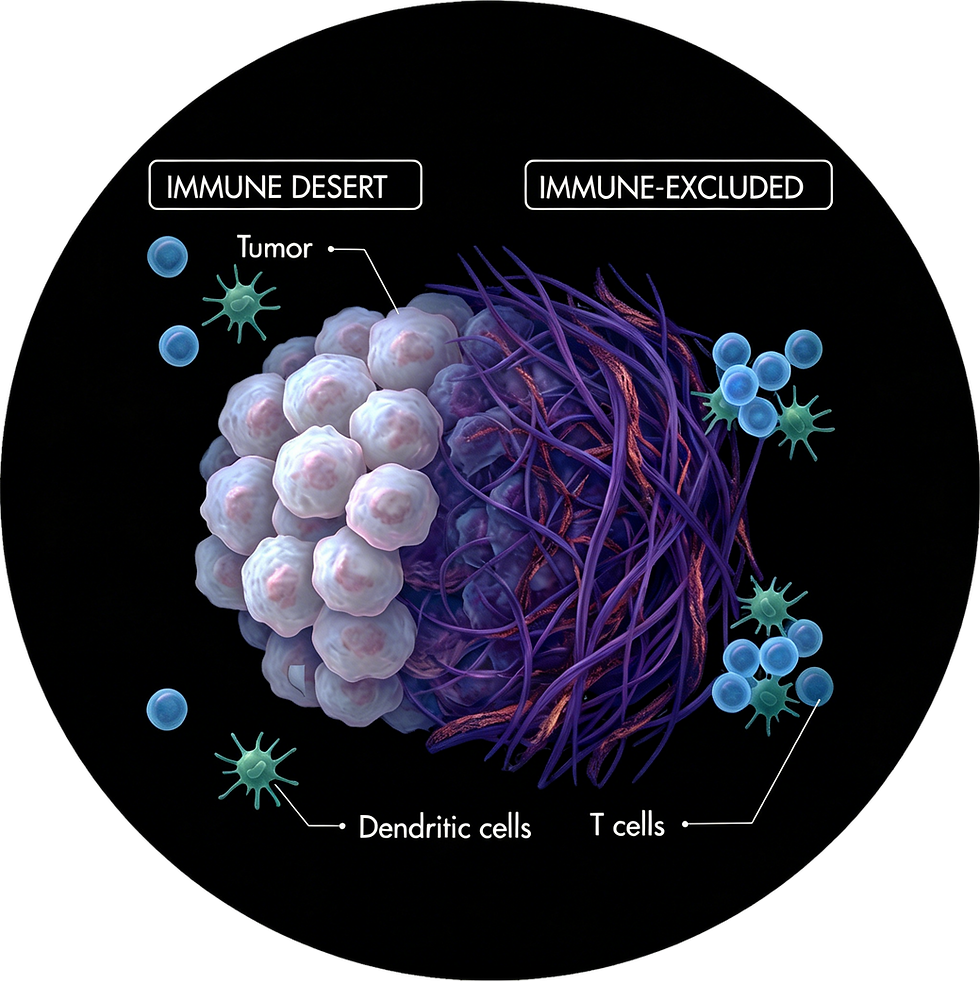
Solid tumors escape immune detection in two common ways. In immune deserts, tumor-specific T cells are absent or insufficient. In immune-excluded tumors, physical and biological barriers block T-cell entry.
Checkpoint inhibitors, bispecific antibodies, and cell therapies depend on active, infiltrating T cells. When that substrate is missing, releasing the brakes is not enough.
XIRT™ is designed to start the engine of the Cancer-Immunity Cycle.
How XIRT™ Works
Preserve everything. Predict nothing.
Preserve the Full Antigen Repertoire
The OmniAntigen™ Platform wraps autologous tumor cells in a supramolecular nanocloak, preserving the complete antigen repertoire, including protein and non-protein antigens, without computational selection.
Activate cGAS-STING in Dendritic Cells
Following dendritic-cell uptake, the nanocloak disassembles intracellularly and releases its immunostimulatory cargo, co-localizing the preserved antigen with cGAS-STING activation and dendritic-cell maturation.
Prime a Polyclonal T-Cell Response
This synchronized antigen presentation and innate activation is designed to generate a broad, tumor-specific T-cell response and drive T-cell infiltration into the tumor microenvironment.
Built on World-Class Research
Biomarker Surge
In preclinical models, OAP-101 increased type I interferon signaling and CXCL10, a chemokine involved in recruiting T cells into the tumor environment.
T Cell Infiltration
XIRT™ shifted the tumor environment from immune-excluded toward inflamed, with increased CD8+ cytotoxic T cells and CD80+ antigen-presenting cells in the tumor bed.
Synergistic Efficacy
In aggressive preclinical melanoma models, XIRT™ combined with checkpoint blockade was associated with greater tumor control than checkpoint blockade alone. Built to potentiate the checkpoint backbone.
Clinical Evidence · The Hardest-Possible Patients
Clinical proof-of-concept where nothing else has worked.
OAP-101 is the upstream immune primer built to create the tumor-specific T cells checkpoint therapy presupposes but cannot make on its own. It is in an active investigator-initiated Phase 1 proof-of-concept study in advanced, low-tumor-mutational-burden, checkpoint-refractory melanoma.
A Demanding Population
Every patient had exhausted checkpoint therapy at enrolment, with no residual disease control (advanced, low-mutational-burden melanoma). These are the ~80% of solid-tumor patients checkpoint monotherapy leaves behind: immuno-oncology's largest unsolved population, and its hardest test.
Safety and Immune Activation
To date, investigators have reported no cytokine-release syndrome or dose-limiting toxicities, alongside a reproducible, dose-coupled pattern of immune activation across distinct molecular backgrounds.
Interim Clinical Observations
Interim, investigator-assessed observations include disease stabilization or tumor growth-rate deceleration within the OAP-101 treatment window. In the lead evaluable patient, investigators have reported overall survival exceeding twelve months and continuing, against an enrollment prognosis of only a matter of months.
DISCLAIMER: OAP-101 is investigational. These interim observations are from an early-stage study and do not establish safety or efficacy.

02.
STING inside the dendritic cell
cGAS-STING activation co-localized in space and time with antigen cargo. Resolves the wrong-cell-wrong-time-wrong-place architecture problem that limited first-generation STING agonist trials.
03.
Hours-not-weeks manufacture
Near-patient manufacture, no gene editing, no cryogenic logistics. The operational profile resembles drug-product manufacture rather than cell-therapy logistics.
Five Platform Moats
Full Antigen Spectrum
Preserves proteins, glycolipids, tumor-associated carbohydrate antigens, and altered lipids, together with cytoplasmic danger signals, without computational down-selection. This full-spectrum breadth is structurally out of reach for protein-only, CAR-T, antibody-drug conjugate, and bispecific formats: an architectural limit, not an engineering gap competitors can close.
STING Inside the Dendritic Cell
Co-localizes antigen cargo and cGAS-STING activation, solving by design the wrong-cell, wrong-time, wrong-place problem that defeated earlier systemic STING-agonist approaches.
Hours, Not Weeks
Near-patient manufacture in hours, without gene editing or cryogenic logistics, against the four-to-ten-week centralized manufacturing cycle that constrains conventional cell therapies. Cell-therapy biology without cell-therapy logistics: same day, not weeks.
Blizzard-grade Clinical Floor
By design, OAP-101 is being evaluated in the hardest patients first: elderly, heavily pretreated, checkpoint-refractory melanoma. A deliberate worst-case stress test, establishing a floor rather than a ceiling.
Combination-Ready
OAP-101 is positioned upstream of checkpoint and cellular franchises. OAP-103 is designed as an in situ companion for antibody-drug conjugates, radiotherapy, and chemotherapy.

One Platform.
Every Indication.
The OmniAntigen™ Platform uses a single programmable architecture to encapsulate autologous tumor cells across indications. The antigen strategy remains constant: preserve the complete repertoire without predicting which antigens will be immunogenic.
What changes by indication is the surface decoration: an indication-matched combination of immune-activating ligands and contextual cues. Novastra uses OmniAntigen™ Forge, its AI design engine, to navigate the combinatorial design space of surface decorations and select the decoration architecture for each tumor setting, while leaving the antigen repertoire intact and unpredicted.
On the Antigen Side
Predict nothing. Preserve the complete repertoire.
On the Design Side
We do not use AI to guess which tumor antigens matter; we use AI to design the decoration layer around the full antigen repertoire.